


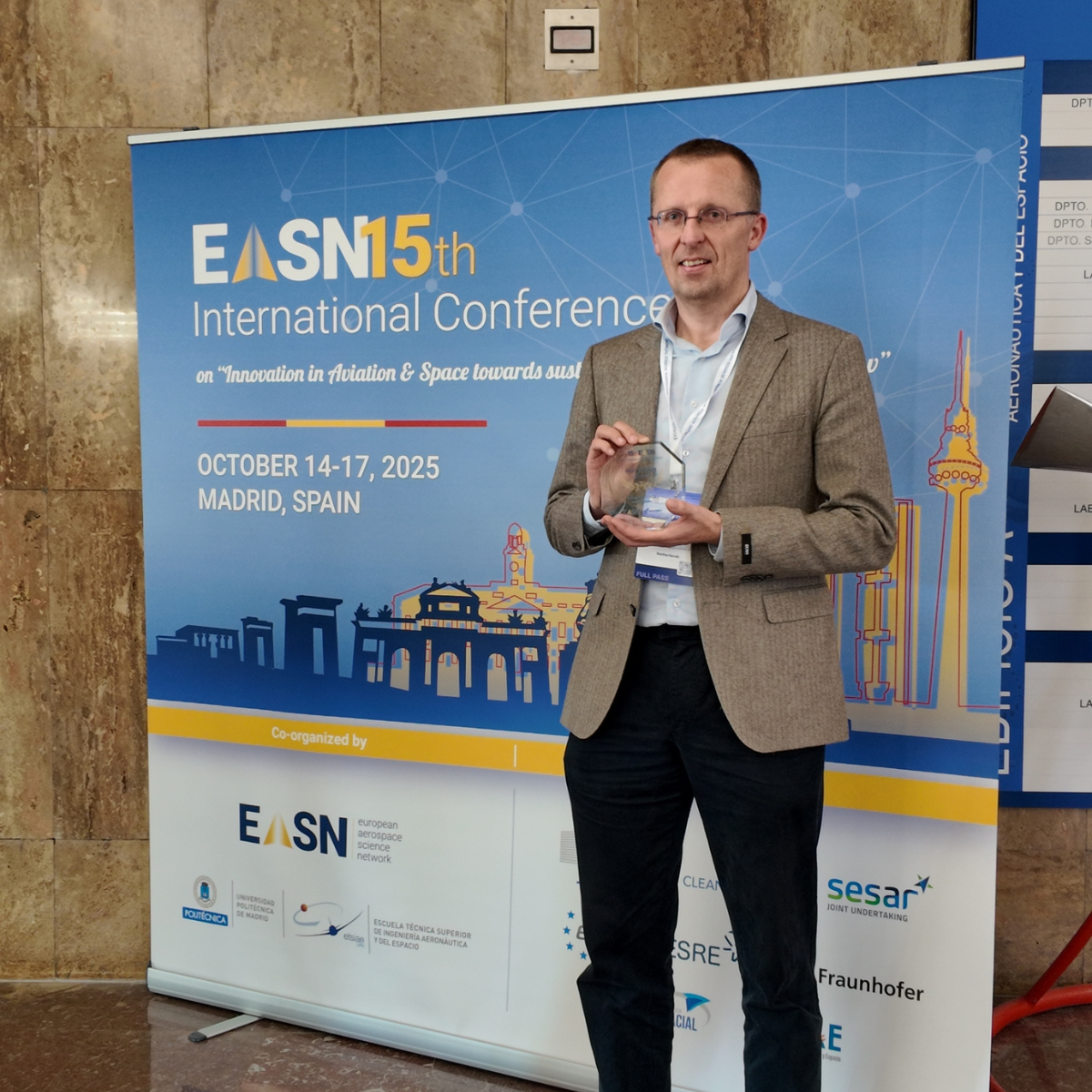
At this year's 15th EASN International Conference, a Poster Section & Competition has been organized for the second time, aiming at spotlighting innovative research contributions in the fields of aviation and space. With over 100 posters submitted, participants showcased their cutting-edge work in a broad spectrum of thematic areas. The evaluation process followed a peer-review methodology, ensuring a fair and thorough assessment by fellow experts.
The "Best Poster Award" was presented to the corresponding author of the winning work, Mr. Bram Noordman, representing his team. Their poster presentation, entitled "Design, analysis and optimization of a vacuum insulated composite conformal LH2 tank", by Bram Noordman, Bert de Wit, Ralf Creemers, Arne te Nijenhuis, Rens Ubels, Karthik Ramaswamy, Amit Kumar Tripathi, Paul Liddel, Jack Cullinan and Leonardo Lecce, was a standout for its forward-thinking approach and impact potential.
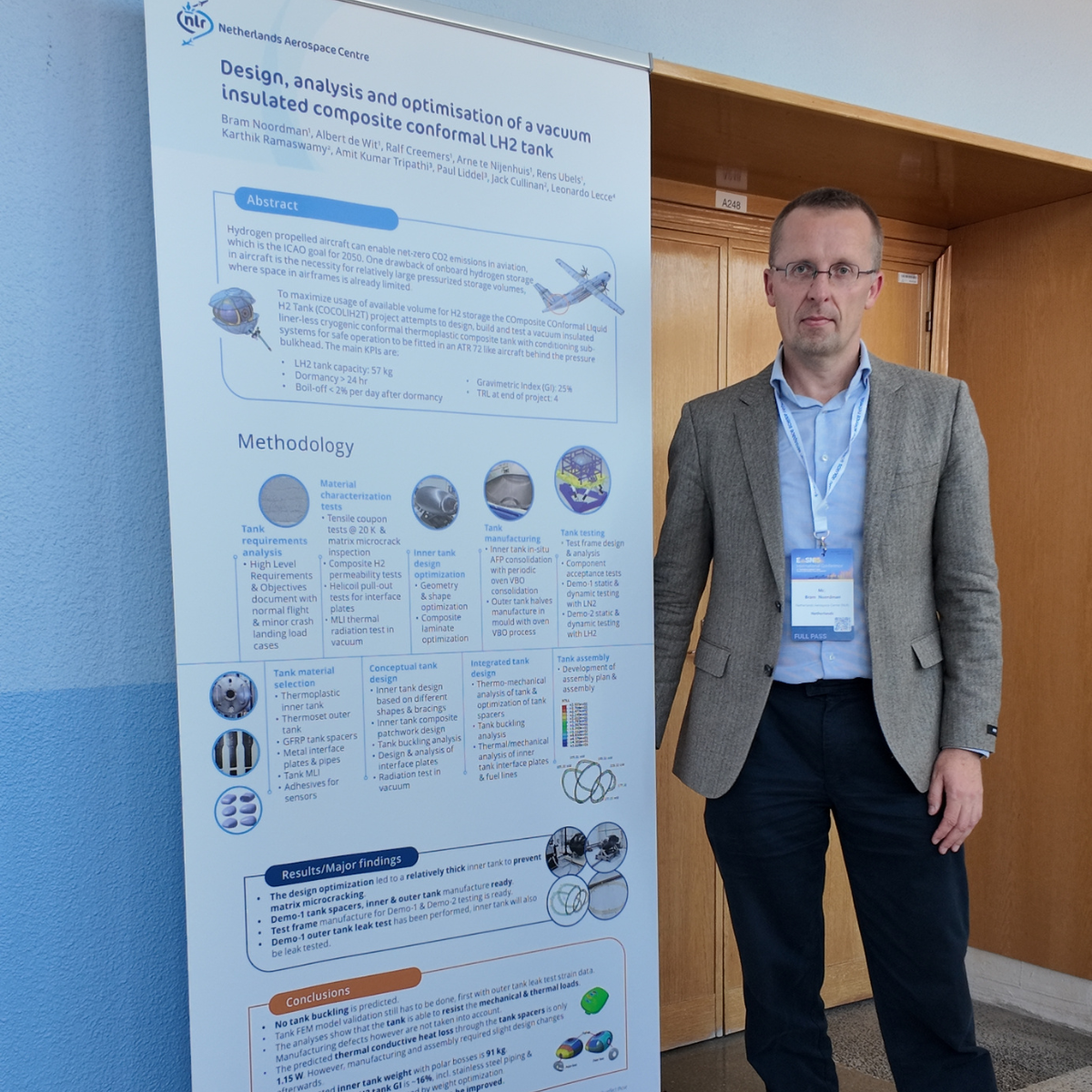
In the following interview, Mr. Noordman shares insights into the research behind the award-winning poster, the innovation of their work, and the expected long-term impact for the aviation sector.
Bram Noordman is an R&D engineer at the Royal Netherlands Aerospace Centre (NLR) in Marknesse, The Netherlands. He obtained his Master’s degree in Mechanical Engineering from the University of Twente in 2004. After graduation, he worked in the automotive industry developing and validating numerical crash test dummy models. In 2006, he joined NLR, where he has since been involved in numerous European and national projects, modelling and simulating metallic and composite aircraft materials and components—from coupon-level specimens up to full-scale structures—validated through physical testing.
In the Clean Hydrogen JU project COmposite COnformal Liquid H2 Tank (COCOLIH2T), led by Collins Aerospace with consortium partners NOVOTECH, ATR, TU Delft and Unified International, he is responsible for the design and optimisation of the tank spacers and has contributed to the thermo-mechanical analysis of the detailed tank design.
Q: As the winner of the EASN Poster Competition at the 15th EASN Conference in Madrid, how would you describe the focus of your work, and what unique innovation sets it apart?
The work presented at the poster sessions in Madrid focused on the design, analysis and optimisation of a vacuum-insulated, composite, conformal liquid hydrogen tank. The tank comprises carbon fibre-reinforced composite inner and outer tanks, separated by glass fibre-reinforced composite spacers with low thermal conductivity, under vacuum. Multi-layer insulation surrounds the inner tank to minimise radiative heat transfer and prevent rapid boil-off of liquid hydrogen.
The key innovations here are:
- A fully composite tank design without a metallic liner, addressing inherent challenges such as permeability, microcracking and thermal fatigue.
- A non-cylindrical, conformal shape optimised for the available space in the ATR 72 rear fuselage behind the pressure bulkhead.
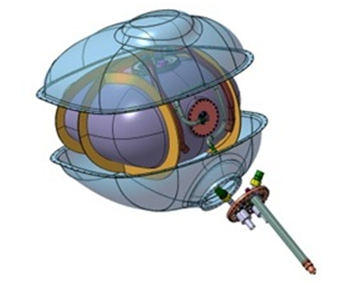
COCOLIH2T’s disruptive liquid hydrogen tank design for Demonstrator 1
Q: What makes your research particularly significant, and how could it shape the future of the aerospace sector in the long term?
The European Commission has set an ambitious goal of climate neutrality by 2050, requiring net-zero greenhouse gas emissions in aviation. Hydrogen combustion can help to achieve this, producing only water vapour and heat, with no CO₂ or NOx emissions.
The COCOLIH2T project addresses the challenges of safe and efficient liquid hydrogen storage for aircraft, enabling future net-zero emissions in aviation. Long-term impact depends on developing hydrogen infrastructure at or near airports and ensuring affordable hydrogen availability.
Q: How would you evaluate the EASN Conference overall, and the poster session in particular? Would you consider submitting another poster in a future EASN conference, and taking part in the competition again?
The EASN Conference in Madrid was very well organised and provides an excellent platform for networking with colleagues from international research institutes, universities, and industry. The poster sessions were well attended, offering insights into how other teams tackle liquid hydrogen storage challenges. I would certainly submit a poster again at future EASN Conferences and also consider giving an oral presentation.
Q: Is there a key message or takeaway you’d like to share with the community?
I would invite readers to follow the website and LinkedIn page for updates on the COCOLIH2T project. The consortium is currently working on a second demonstrator tank, incorporating lessons learned from the first tank, which was already manufactured by NOVOTECH.
The second composite demonstrator tank will be produced at NLR using Automated Fibre Placement (AFP). After fabrication, it will undergo pressure testing to check leak tightness, followed by filling with liquid hydrogen at NLR’s Energy to Propulsion Test Facility (EPTF) in Marknesse (NL). This will demonstrate key aspects such as fuelling, refuelling, gauging, sloshing behaviour and mechanical load resistance, aiming for Technology Readiness Level (TRL) 4. So there is a lot more to look forward to.
Funding: This research is co-funded by the EU Clean Hydrogen Partnership, Grant Number 101101404. The project is supported by the Clean Hydrogen Partnership and its members. Views and opinions expressed are those of the author(s) only and do not necessarily reflect those of the European Union or the Clean Hydrogen Joint Undertaking. Neither the European Union nor the granting authority can be held responsible for them.

COCOLIH2T website: www.cocolih2t.eu