



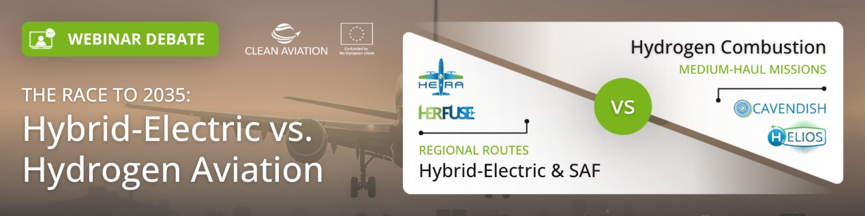
The Race to 2035: Hybrid-Electric & SAF vs. Hydrogen Aviation
Clean Aviation Projects Unite in High-Level Webinar Debate on the Future of Sustainable Flight: A Timely Debate for Aviation’s Decisive Decade
By 2035, aviation is expected to take significant steps toward reducing emissions while maintaining connectivity and competitiveness. Yet major questions remain regarding which technological solutions can scale fastest, achieve certification, and provide the most effective route to market.
The webinar will explore two leading pathways:
Hybrid-Electric Aviation & Sustainable Aviation Fuels
Represented by HERA and HERFUSE projects, this approach focuses on regional aviation concepts that combine hybrid-electric architectures with Sustainable Aviation Fuels (SAF), leveraging existing infrastructure while advancing aircraft efficiency and emissions reduction.
Hydrogen Aviation
Represented by the H2ELIOS and CAVENDISH projects, this pathway investigates liquid hydrogen storage, aircraft integration, and hydrogen combustion technologies that could revolutionise medium-haul air transport and significantly reduce aviation’s environmental footprint.
What Participants will Learn
During the 60-minute debate, project experts will present evidence and perspectives on:
- Technology readiness and certification challenges
- Infrastructure and airport adaptation requirements
- Energy efficiency and operational realities
- Regional versus medium-haul mission requirements
- Hydrogen integration and combustion technologies
- The role of SAF in aviation decarbonisation
- Future investment priorities for industry and policymakers
- Opportunities for collaboration across different technology pathways
The discussion will also include a live audience Q&A session, allowing the attendees to engage with leading European researchers and innovators directly.
More Than a Competition
While the webinar will explore the advantages and limitations of competing technological approaches, its ultimate objective is
to foster dialogue across the aviation innovation ecosystem. The discussion will demonstrate that the future of sustainable
aviation is unlikely to be defined by a single solution. Instead, hybrid-electric systems, SAF, hydrogen storage technologies, and
hydrogen combustion concepts may all contribute to achieving Europe's long-term aviation sustainability goal.
Event Details
Title: The Race to 2035: Hybrid-Electric & SAF vs Hydrogen Aviation
Date: 2 October 2026
Time: 15:00–16:00 CET
Format: Online Webinar Debate
Projects: HERA (Giuseppe Piscopo & Massimiliano Di Giulio), HERFUSE (Fabrizio Leone), H2ELIOS (Emma C. Lope), CAVENDISH
(Andreas Frenzel & Hervé Morvan)
Moderator: Antonello Marino (Team Leader - Project Management Unit, Clean-Aviation JU)
Programme: Clean Aviation Joint Undertaking
Participation is free of charge.
For further information, please contact the media creator, Vassiliki Vgenopoulou, Dissemination & Communication manager of the HERA project.
HERA at the 16th EASN Conference in Toulouse
The Race to 2035: Hybrid-Electric vs Hydrogen Combustion: Which of these two pathways is expected to achieve certification first by 2035, and why?”
𝖳𝗁𝖾 Race to 2035 detabe continues in Toulouse, at the 𝟣𝟨𝗍𝗁 EASN International Conference, only this time addresses the certification challenges associated with the two sustainable aviation approaches.
The debate session at the EASN Conference will take place on Friday, October 30 (DAY 4), from 10:30 to 12:30.
The participants in the roundtable discussion will be:
- Mario Pirozzi (LEONARDO) representing HERFUSE
- Emma C. Lope (ACITURRI) representing H2ELIOS
- Andreas Frenzel (ROLLS-ROYCE) and Herve Morvan (ROLLS-ROYCE) representing CAVENDISH
- Piscopo Giuseppe (LEONARDO) representing HERA
In the moderator role, we are honoured to have with us Emmanuel Isambert, Research and Innovation Project Manager at EASA.
The debate will address a key question for the future of sustainable aviation:
The Race to 2035: Hybrid-Electric vs Hydrogen Aviation
Hybrid-Electric & SAF for Regional Routes vs Direct Hydrogen Combustion for Medium-Haul Missions
Which of these two pathways is expected to achieve certification first by 2035, and why?
Explore the conference agenda and join the debate!


The project is supported by the Clean Aviation Joint Undertaking and its members.
Funded by the European Union. Views and opinions expressed are however those of the author(s) only and do not necessarily reflect those of the European Union or Clean Aviation Joint Undertaking. Neither the European Union nor Clean Aviation JU can be held responsible for them.