


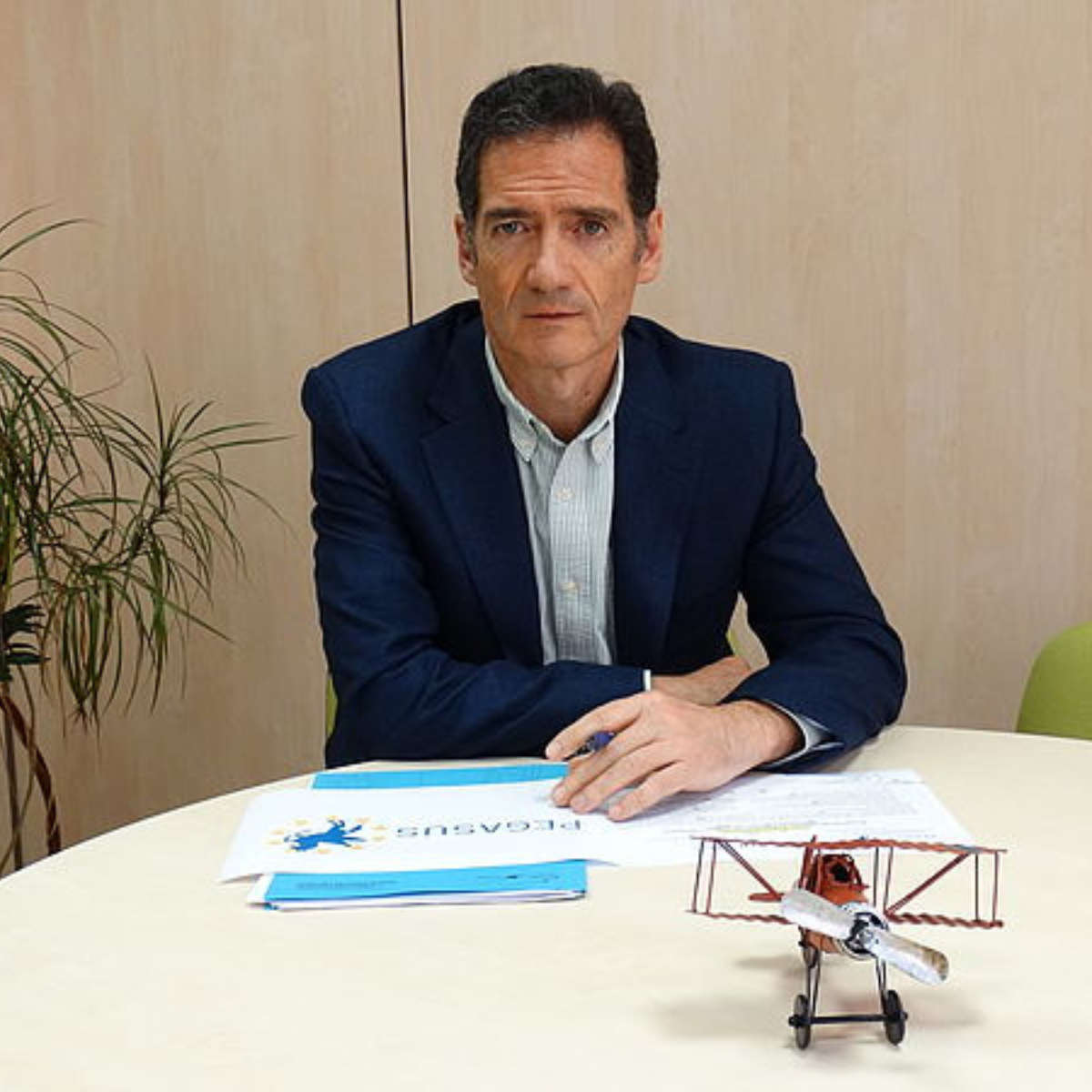
Prof. Gustavo Alonso received a master’s degree in aerospace engineering from Universidad Politécnica de Madrid (UPM) in 1990, an MBA from IESE in 1998 and a Ph.D. in aerospace engineering from UPM in 2005.
He is currently Professor at the School of Aerospace Engineering of UPM, where he serves as Director since 2024. Prof. Alonso lectures in Systems Engineering and Air Transport subjects. His research is focused presently on the environmental impact of aviation and its mitigation. He is a visiting professor at several Universities in Europe, the US, and Asia. Before joining the University in 2005, he was working for the European Space Agency and different engineering companies for 15 years.
He is currently Vice-Chairman of EASN and a member of the board of PEGASUS, the association of European aeronautics and space Universities.
This interview has been based on the keynote speech delivered by Prof. Alonso at the 15th EASN International Conference, which took place on October 17, 2025, in Madrid, entitled "Is the European Aerospace Engineering Education Ecosystem Prepared for the Transformation of Aerospace?"
Q: The aerospace sector is undergoing profound transformation. From your perspective, what are the main forces reshaping the industry, and how do they challenge traditional aerospace engineering education?
We are witnessing one of the most significant inflection points in the history of aerospace. Four major drivers—sustainability, digitalization and AI, social shifts, and geopolitics—are converging to reshape how aerospace systems are conceived, designed, certified, and operated.
Sustainability is arguably the most immediate and publicly visible pressure. Climate change, societal reaction to air travel, and increasing regulatory constraints on emissions and noise require the sector to rethink its technological foundations. Even basic assumptions about traffic growth, airport expansion, and environmental acceptability are being questioned. The limits placed on infrastructure development, rising concerns about tourist saturation, and growing political intervention in environmental matters require engineers capable of navigating technological, regulatory, and societal complexity simultaneously.
Parallel to sustainability, project complexity has exploded. Major aerospace programs face high costs, long timelines, and the recurring problem of being “late and over budget.” This is not a temporary deviation—it is structural, driven by increasingly multidisciplinary systems involving software, materials science, human factors, alternative energy systems, and integrated mission architectures. The trend line shows clearly that technical complexity is rising faster than our capacity to manage it using traditional tools and organizational structures.
At the same time, a revolution in enabling technologies—AI, data science, digital twins, Internet of Things, Industry 4.0, advanced materials, miniaturization, cryptography, quantum technologies—demands that aerospace engineers be conversant not only in classical aeronautical disciplines (aerodynamics, structures, …) but also in fields that were peripheral or nonexistent just a decade ago.
The transformation is also anthropological. Today’s students are digital natives with new expectations about learning environments, modalities, and professional trajectories. They demand hands-on, project-based, interdisciplinary learning, and they move seamlessly across remote and on-site formats. This evolving learner profile requires institutions to rethink how they teach, assess, and support the next generation of engineers.
Finally, geopolitics places aerospace at the heart of Europe’s strategic autonomy, industrial sovereignty, and defence capabilities. The sector is increasingly tied to Europe’s geopolitical identity.
In short, the aerospace sector is transforming not only technically but also culturally and institutionally. These forces compel European universities to modernize curricula, accelerate institutional agility, and integrate digital and sustainability competences at an unprecedented pace.
Q: How would you describe the current state of the European aerospace engineering education ecosystem? What makes it unique, and where do you see its strengths and structural challenges?
The European aerospace engineering ecosystem is diverse, multilayered, and fundamentally decentralized, reflecting Europe’s broader socio-political fabric. It is composed of universities, research centers, industry partners, and public institutions working together within a shared but highly heterogeneous framework.
A first defining characteristic is the heterogeneity of institutions offering aerospace engineering education. Depending on one’s definition—specialist aerospace departments only, or all programs carrying an “aerospace/aeronautical/astronautical” label—the number of institutions ranges from about 40 core universities (the PEGASUS network members plus a few others) to well over 100 when including broader engineering programs with aerospace specializations.
This fragmentation requires a dense network of European-level cooperation frameworks:
- PEGASUS, which gathers 31 key institutions in 12 countries and works on quality enhancement, curriculum improvement, industry alignment, and attractiveness to international students.
- European University alliances (UNIVERSEH, EuroTeQ, ENHANCE, Unite!, EELISA) that promote joint curricula, mobility, and integrated education-research-innovation strategies.
- EASN, as a broad association networking academia in aviation and space research
- Additional networks such as CEAS, ECATA, and institutional partnerships and organisations such as Clean Aviation, SESAR, and EASA, which provide scientific, regulatory, and industrial bridges at European scale.
These structures reflect Europe’s ability to foster cross-border collaboration while embracing local diversity.
Yet this ecosystem faces several challenges.
Compared to the USA and China, Europe suffers from fragmented funding, especially regarding large-scale R&D and digital infrastructure. The continent lags behind in average R&D spending compared to significantly higher levels in the USA and China, and this directly impacts the modernization of laboratories, digital testbeds, and educational experimentation environments.
Similarly, curricular agility remains moderate. European universities, shaped by national qualification frameworks and accreditation systems, often struggle to update programs rapidly enough to incorporate fast-moving fields such as AI, advanced data science, or quantum technologies.
Finally, a major structural weakness is the limited culture of lifelong learning, despite the fact that aerospace engineers increasingly need to update their skills several times during their career. This contrasts with the needs imposed by the accelerating technological cycle of the aerospace sector.
Europe’s ecosystem is rich, collaborative, and technically strong—but not yet fully adapted to the speed and scale of the industry’s transformation.
Q: Based on the evidence and your analysis, is Europe prepared for the coming transformation? How does it compare with other global education systems?
Europe is partially prepared, but not yet ready to meet the demands of the aerospace transformation unless it overcomes fragmentation and scales up investment efficiency.
Europe performs strongly in sustainability alignment and possesses world-class universities, companies, and research institutions. However, it shows only moderate performance in digital and AI integration, infrastructure modernization, and curricular agility—and weak performance in lifelong learning.
When compared globally, the contrast becomes clearer:
United States:
- A unified system supported by strong federal agencies (NASA, DoD).
- Large, well-funded universities with autonomy.
- Rapid curriculum adaptation and strong industry–academia ties.
China:
- Centralized strategic planning and massive investment.
- Rapid scaling of institutions and infrastructure.
- Strong alignment between academia, industry, and government.
Europe:
- Fragmented national and regional systems.
- Smaller institutions with fewer resources.
- Fragmented and less efficient R&D investment.
- Slower curriculum updates and lower cohesion.
The conclusion is clear: Europe’s principal obstacle is not a lack of talent or expertise—it is the fragmentation that prevents it from acting with scale, speed, and strategic unity.
Q: What concrete steps should Europe take to ensure its aerospace engineering ecosystem remains competitive, innovative, and aligned with future industry needs?
Europe must pursue five strategic lines of action, all tied directly to addressing fragmentation and increasing innovation efficiency.
1. Reduce fragmentation through deeper European coordination
Harmonize accreditation, create faster pathways for joint degrees, and strengthen EU-level governance in aerospace education and research. Shared frameworks will allow programmes to adapt more quickly to technological change.
2. Consolidate infrastructure and pool resources
Europe must create large, shared testbeds and digital-experimental platforms instead of maintaining many small, sub-critical facilities. This is essential to match the scale seen in the USA and China.
3. Increase and rationalize R&D investment
Europe must invest more and invest smarter. Fragmentation dilutes impact; cross-border coordinated programmes can significantly increase efficiency.
4. Expand and institutionalize high-TRL collaboration between universities and industry
Engineering universities must become full partners in TRL 4–7 research. They should engage in demonstrators, prototyping, system integration, and operational validation. This strengthens educational quality and boosts Europe’s industrial competitiveness.
5. Strengthen lifelong learning across Europe
Flexible micro-credentials, modular EU-wide learning platforms, and industry-integrated training will allow engineers to update skills at the pace demanded by technological change.
Finally, Europe must reaffirm the broader mission of universities: to combine intellectual freedom and critical inquiry with responsiveness to societal and industrial needs. This balance is essential for Europe’s competitiveness and cultural identity.
Ultimately, Europe’s preparedness will depend not only on technological upgrades but also on cultural, institutional, and pedagogical evolution.