



H2ELIOS Project — Advancing Cryogenic Hydrogen Aviation: Latest Highlights from 2025
As H2ELIOS moves dynamically through 2025, we are proud to present a series of new achievements that reflect our continuous progress in cryogenic hydrogen storage systems, material testing, research dissemination, and community building.
H2ELIOS on the Rise — Research & Conference Highlights
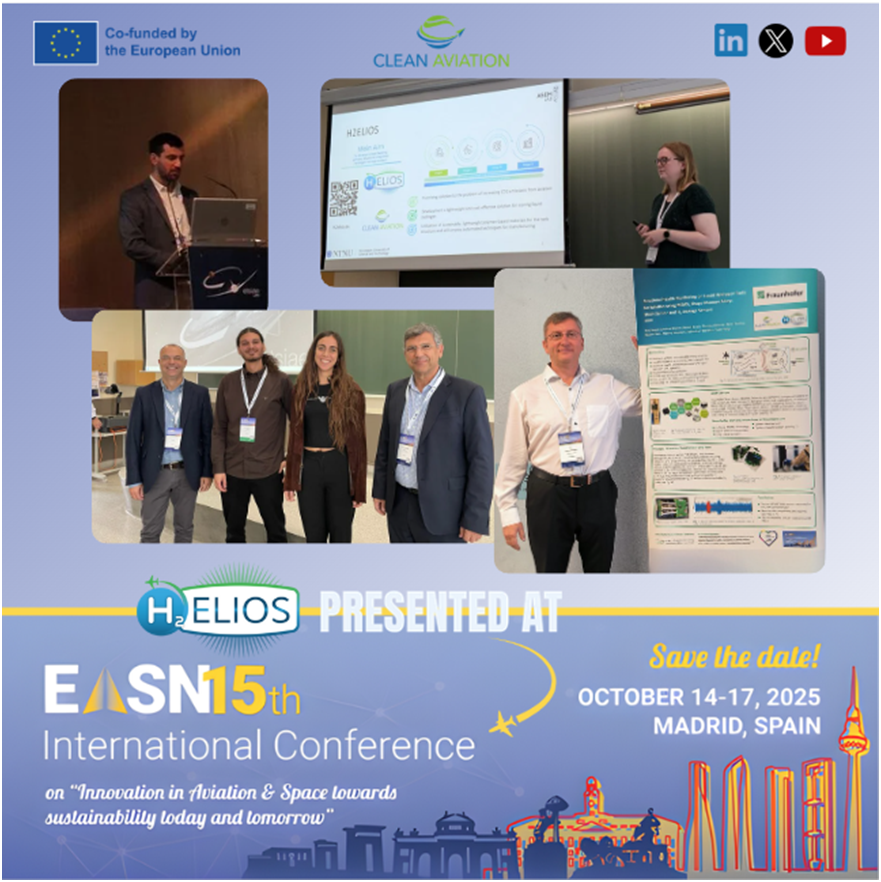
EASN 2025 Conference (Madrid, Oct 2025): Researchers from NTNU, University of Patras, and Fraunhofer ENAS represented H2ELIOS, presenting recent advances in hydrogen storage solutions, cryogenic tank performance, and material testing under demanding conditions. The event reinforced H2ELIOS’s role in shaping the future of clean and sustainable aviation across Europe.
- LCM 2025 — Life Cycle Management (Palermo, Sep 2025): H2ELIOS showcased research on insulation materials for cryogenic hydrogen tanks. The study, presented by Andrea Pettersen Helåsen (NTNU), conducted a life-cycle assessment comparing traditional and novel insulation solutions, underlining the environmental impact of material choices across the tank’s life span — from manufacturing to end-of-life. This work supports H2ELIOS’s commitment to sustainable design beyond performance.
- EUCASS 2025 (Rome, Jul 2025): The project’s technical developments were further disseminated through the presentation titled “Insulation Optimization of Dual-Foam Insulated H₂ Cryogenic Tank” by Ahmad Amani (UPC–CTTC). The study explored advanced dual-foam insulation strategies aiming for optimal thermal performance and minimal weight — a critical balance for future liquid hydrogen-fueled aircraft.
- New Study on Structural Monitoring: In August 2025, H2ELIOS released a publication on the use of optical fiber sensors to enhance structural health monitoring of cryogenic composite tanks. This innovation is key to ensuring long-term safety and integrity of hydrogen storage systems, especially under the cryogenic and cyclic stresses expected in aviation applications.
Strengthening the Consortium: Collaboration & Outreach
The recent wave of research dissemination and conference participation highlights the growing collaboration among H2ELIOS partners, ranging from academia to research institutes and industry stakeholders. Through these efforts, H2ELIOS reaffirms its commitment not only to technological breakthroughs, but also to transparent knowledge sharing and community engagement within the European aerospace ecosystem.
What This Means for the Future of Hydrogen-Fueled Aviation
The recent research on insulation, cryogenic tank design, structural monitoring, and life-cycle sustainability all converge towards a core objective: developing hydrogen storage solutions that are lightweight, thermally efficient, safe, environmentally sustainable — and ready for certification. With H2ELIOS’s efforts spanning from fundamental material studies to system-level integration and life-cycle analysis, we believe these developments bring hydrogen-powered aircraft one step closer to operational reality.
We encourage all members of the aerospace community — stakeholders, researchers, industry partners — to explore these updates, share the findings, and engage with us as we advance toward a cleaner, hydrogen-fueled future of aviation.

The project is supported by the Clean Aviation Joint Undertaking and its members.
Funded by the European Union. Views and opinions expressed are however those of the author(s) only and do not necessarily reflect those of the European Union or Clean Aviation Joint Undertaking. Neither the European Union nor Clean Aviation JU can be held responsible for them.